Aerial Operations - The Aerial Truck Check, Part 1

Here is a look into how my Aerial truck check goes.

I usually start my Aerial truck check by walking around the Truck and checking for any obvious signs of an issue. Any issue, such as scratches dents, paint chips, doors missing, broken glass, you know the obvious things.

The next thing I do is go to the saw compartment. I take each of the gas- powered saws out of their compartment and start them. I allow them to idle outside is a position that they won’t wander off. If you don’t know what I mean here, just start a saw and place it on the ground in front of you. The saw will slowly wander off as it idles. So, place it in a crack in the ground or up against the wall of the firehouse. (NOTE: Make sure it doesn’t vibrate on anything that may become damaged, like paint on the firehouse wall.) I allow the saws to run the entire time I am checking the Truck. When Im done checking the truck, I fuel the saws, check bar and chain oil, and place them in service. The reason I do this with the saws is to allow them to run and get up to temp. It helps keep a healthy saw. Now there is a lot more to the saws here, but this is where I will stop for now.

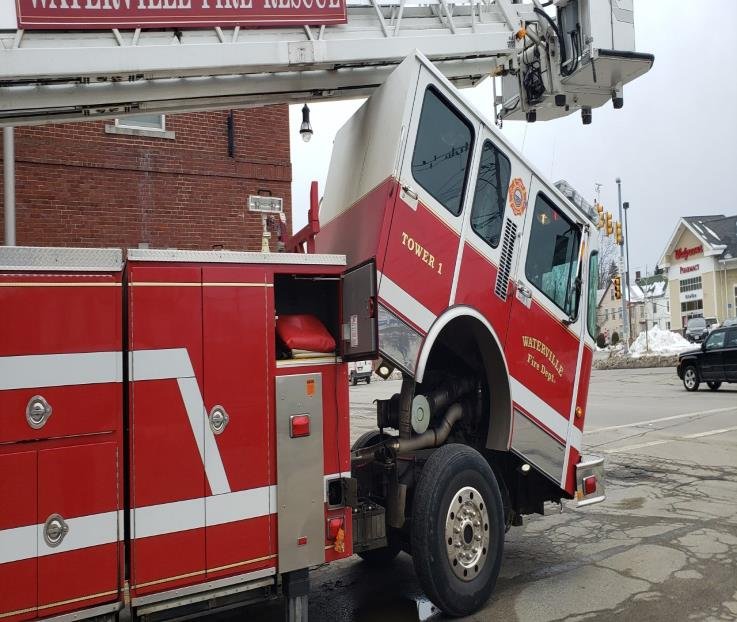
Next thing I do is pull the truck out of the bay. I am going to check the engine fluids of the truck. Some trucks you have access points to allow you to do this. I prefer to raise the ladder and then raise the cab of the truck. This allows me to get eyes on the undercarriage. I check the fluids, oil, transmission, window washer, and the DEF. I will check Hydraulic oil and the generator fluids at this time as well.

Continuing under the cab, I check the belts, pulleys and anything bolted on the motor. Especially that alternator. I don’t know why but, these have a habit of losing bolts. In our Aerial class one of the things that we do is a truck check before operating the truck. We have found more than once, a loose or missing bolt and have had to send someone to get a bolt to continue the class.

Once the motor and it’s various parts are in working order I move on the exhaust, brakes, and springs. Making sure all are in tact with no “shiny” metal. This usually means there is something broken. Lets hope whatever is broken, let’s say a spring, that it is shiny and not all rusted, if it is rusty this means it has likely been broken for some time and maybe we missed it on our last truck check.

THE AERIAL TRUCK CHECK

While the cab is still up check the back side of the tires for any deformities low tread, bubbles, chunks missing. Remember these are Emergency Vehicles, not a fleet truck. If there are any issues at all document it and bring it to the attention of the proper person. For me it is an e mail to the maintenance supervisor and the OIC for the day.

As we continue under the cab we grab a creeper, if you have one, and begin to roll under the truck. Now with the Aerial up and the cab in the air it should be obvious to others there is a truck check going on, but to be safe place an Out of Service tag on the vehicle to your department SOG’s. This way you ensure that no one will run the truck while you are under it.

Continue to check for obvious issues, again broken springs and other hardware. Check the hydraulic lines, any coolant lines that may run here. Air brakes and the cans in the rear. It’s a good idea to drain the air tanks while you are here, this will remove the moisture from the air tanks and help prolong your airbrake system.

Look for anything leaking fluid. Investigate it. I know some trucks have their quirks but again these are Emergency Vehicles.

Check the inside tires for any issues, check air pressure on all tires, top off to your truck’s specifications.

Next month we will dive into the compartments of the truck and the aerial. Please remember this is just a way to do something and hopefully give you a few tips along the way. My approach is systematic and works for me. It may not all work for you. As always if you have something that may help, drop me an e mail and Ill put in here! Oh and BTW, the saws are still running, make them ready and put em back on the truck!

Peaked Roof Ventilation

The Cuts

There are many types of cuts, and we will discuss a few. But the main objective is to release the heat, smoke, and toxic gasses. To do this your hole size needs to be big enough to make a difference. Unfortunately, the day of the 4x4 hole is over. This size just doesn’t release the amount of heat needed to be effective. With all the synthetics and plastics in today’s homes, and the rate of heat release these products produce, it just makes sense to make the hole larger. You may not find this in many books, but from my experience and the experience of other like-minded Firefighters I network with; we agree that at least a 4’x6’ hole is the new minimum.

There are many ways to accomplish this size and larger hole. I am a big fan of two cuts. The Louver cut and The Milwaukee cut. Each has their place. Now there are many more to consider but these are the two I am going to talk about.

THE LOUVER CUT

A two panel louvered cut on a residential roof will provide an opening that is about 4x8 foot. Starting at a high point, near the ridge and working your way across the top. Start your cut by plunging your saw into the roof, slide the saw to the left until the resistance is greater. This means you have hit the roof rafter. Now slide the saw in the same kerf cut to the right until that heavy resistance is meet again, now roll the rafter. To roll the rafter, you lift the saw out of the roof material and cut just the sheeting not the rafter. Then as you have gone over the rafter plunge the saw again until the next rafter. Continue this for process. Cut, roll the rafter, cut, roll the rafter, and cut to the rafter. This will give you about six feet in length. Now cut downward toward the soffit, about four feet. If you’re unsure how far four feet is, count rows of shingles. Each row is about six inches. That’s a foot for every two rows. Cut down eight rows. Now work your way back. Same cut and roll method. This time after you roll the rafter, stop. Reach up to the top cut, make a cut from your top cut to the bottom cut. This should be half way between the rafters. Continue working your way back to your roof ladder. Make the last vertical cut and now wait for the word to open up. Punch through with your six-foot hook, the roof material will “louver” on the rafter.

After the cut is made do not forget to punch through the ceiling material to allow for proper ventilation. As soon as the cut has been made, firefighters should evacuate the roof as quickly and as safely as possible.

THE MILWAUKEE CUT

The Milwaukee cut is a great cut that catches all aspects of your roof. It runs from the peak to the soffits. It is usually around four feet wide. To start the cut is just like the start of your louver cut. The only thing I would add is an inspection cut at the top left and right. This becomes important when you are ready to pull the material from the cut. As this allows you to get the hook into the material and pull. I should add that it can be done with a rotary saw as well as a chain saw.

This cut is labor intensive. It can be done with two Firefighters but 3 is optimal. You will need two roof ladders, one on each side of your cut. How you accomplish this cut is up to you. Meaning that you can run two saws or one. But I like the old adage that two is better than one.

Either way, after making your cut across the top and then making your inspection hole, continue the vertical cut all the way to the soffit on both sides.

Climb back to the peak and begin pulling the material from the cut. Again punch through the ceiling material.

The advantage to this cut is in a lot of New England homes there are many voids in the roof area. Especially in Cape Cod style homes. With the attic space above and the knee walls all open this allows you to properly vent the whole structure

SAFETY CONSIDERATIONS

Pitched roof ventilation can be one of the most hazards operations on the fireground, yet it is one of the most important assignments.

There are numerous things to consider when working on a roof. Number 1 the fire is under you! Sounding the roof is a must, know and understand the sound of a solid and a spongy roof. Know that in older homes the ridge and valleys are usually the strongest, but still sounding is a must.

Use a roof ladder whenever you can. Yes you can walk a pitch of 6/12 or less but err on the side of caution. If you cannot see, meaning heavy smoke conditions, then get on your knees. When you have an SCBA on you have balance issues, add a pitched roof and low to no visibility, this could be a bad combination. Always try to work your way back to your roof ladder. This may not be able to be done 100% of the time but do it as much as you can. Know the signs of a bad roof. Bubbling shingles, smoke slithering from under shingles or through metal roofing. Any sags in the roof or in between the rafters. Understand building construction, especially roof construction. Understand what types of roofing material is on the roof, how many layers of shingles and sheeting material. If you are unaware of the construction type, then cut inspection holes. This may save you some time and may even save your life.

Mother nature is always messing with us. From snow to sleet to freezing rain. Be aware of these conditions and take appropriate actions. Use of a roof ladder even on a low pitch is a good start. Some type of striking tool, should already be in your tool selection, to break away the ice, maybe add a shovel as well.

Get out in your community and see what’s out there! Because you don’t know what you don’t know!

For more, check out Ryan Johnston and MAINE-IAC Training. www.maineiactraining.org

Follow Ryan on Instagram @maineiactraining

Remembering Firefighter John Nance

10:10 pm, the Columbus Division of Fire was dispatched to North High Street for a report of

smoke coming from the 1st floor of the Mithoff Building. At 10:12 pm, Engine 1 arrived on the scene

immediately, followed by Engine 9 and Engine 3. Firefighter John Nance was acting Lieutenant on Engine

3.

The Division of Fire used a “battle plan” consisting of two task forces to fight downtown fires.

Acting Lieutenant Nance was with Taskforce two and was staged at the rear of the building. His crew

noticed smoke hanging low to the sidewalk, indicating a basement fire. Nance and his crew from Engine

3 entered the building, joined by teams from Ladder 2 and Engine 2 shortly after. The smoke was so

dense the crews were forced to crawl while advancing the charged hose line.

Approximately 30 minutes into the incident, a second alarm was transmitted. While there was

still no visible fire, the smoke was increasing. Met with a significant amount of smoke and heat, Nance

and his crew continued to search for access to the basement. Unable to access the basement and

quickly exhausted, Nance and his crew vacated the building to cool down and switch out air bottles.

Now, after numerous research attempts, it seems no one knows what happened to Firefighter

John Nance other than he fell through the floor into the basement. A hole was found where he fell

through, leaving firefighters and officials to believe he was cutting a hole to the basement. Firefighters

were attempting to rescue FF Nance utilizing ropes and hose lines. As the fire began to show, Nance had

run out of air. The Assistant Chief started to remove people from the fire. Using a “search rope” type

technique, firefighters once again entered the building in a final attempt to save FF Nance. Firefighters

were again pulled from the building; last attempts were made to gain access to firefighter Nance, but all

turned empty.

Eventually reaching the 4th alarm, the fire was placed under control around 5 am.

Unfortunately, FF Nance did not make it out of the fire, and his body was recovered on the afternoon of

July 26th. According to reports, the building was intentionally set on fire, making this line of duty death a

murder.

As always, a line of duty death results in training tactics for firefighters. This LODD brought us

the “John Nance Drill” or “Hole in the floor.” The drill removes firefighters from a basement should stairs

or easier access not be available. I have attached a link to watch it here

https://www.youtube.com/watch?v=umzJmtMHrdA this incident also shows the importance of using a

search rope or tag line. Although firefighters had a hose line to follow in this incident, a search rope still

provides an additional tool to help guide a firefighter out and to assist firefighters in to assist a downed

firefighter should anything happen.

I must admit, when looking for my LODD topic this month, I was unaware of John Nance. As I

researched it and found multiple articles and stories, I became a bit obsessed with always looking for

more information. To my knowledge and what I have seen, the murder has yet to be solved, officials and

investigators have found why the building was set on fire but have yet to find out who started it. I found

a story written by Michael Norman on FFprovinggrounds.com. Mr. Norman, a writer for Columbus

Monthly, provides detail on the incident in his write-up. I encourage anyone unfamiliar with this to do

an internet search and read up on it.

**Video link provided by FFprovinggrounds YouTube page**

Food Trucks and Firefighting Concerns

For decades food trucks and food carts have been service food to people on street corners, carnivals and events all around the world. In today's world, food trucks and food carts are popping up everywhere. From birthday parties to school and work functions you name it and a food truck is probably there serving food. These carts or trucks are known as Mobile Food Preparation Vehicles or MFPV for short. Some are trucks designed to house a kitchen setup and others are trailers pulled by a truck or SUV. Either way both serve the same purpose, preparing food for customers.


These trucks provide a unique set of challenges for firefighters and provide a few hazards that commonly scene when fighting vehicle fires.


We are very well aware that cooking is the leading cause of accidental fires in the United States with respect to residential fires. With respect to commercial occupancies, these structures are more well equipped to handle the potential of an accidental mishap in the kitchen. Commercial kitchens mitigate the risk through hood suppression systems over their cooking appliances such as ovens, burners and grills. The same goes for MFPVs…but not exactly.


The newly designed, custom-built food trucks will be equipped with hood suppressions systems however the older retro-converted trucks may not be as equipped. Making the workers not as fortunate should an accidental kitchen fire breakout. In all cases, all MFPVs will be equipped with portable fire extinguishers to suppress kitchen fires from grease, fat and cooking oils.

 Propane Tanks

The most significant risk of fires to MFPVs are propane tanks. According to the NFPA, 68% of food truck fires are related to leaks or failures in the propane tanks themselves. Propane is used in various ways with respect to food trucks. For one, they're used as fuel for cooking and possibly refrigeration.


While propane is generally safe to cook with, a small 20-pound cylinder on a backyard grill has the explosive equivalent to 170 sticks of dynamite. MFPVs can carry around 100-pounds of propane cylinders at a time in order to be efficient and produce food services to customers. One hundred pounds of propane is capable of producing more than 2.6 million BTUs (British Thermal Units). One food truck carrying that amount of propane can generate 6 times more energy from an exploding propane tank than a backyard grill using a 20-pound propane tank.


Since these trucks are constantly moving from place to place, the risk of a propane failure can increase. This is due to the trucks driving on bumpy terrain or hitting potholes. Both of which can loosen the connections and fittings or cause structural damage to the tank. With respect to air, propane is heavier. In fact, propane is 1.55 times heavier than air which causes it to sink. Thus, causing a pooling effect near the floor should a tank leak. Because of this, a single spark from the cooking appliances has the potential to ignite the gas.


Many trucks carry spare tanks or have their current tank fitted to the outside of their MFPV which decreases the risk of leaks inside the unit. The risk this does carry is tank explosions from minor collisions on the roadway or single vehicle accidents.

 Generators

Older MFPVs are more likely to pose a risk with the use of portable generators. These are used to run electricity to the truck. Older MFPV's or converted ones could possibly lack the proper ventilation of the off gases from the generators which raise the risk of carbon monoxide emergencies in the mobile unit. 

 Past Incident

On July 1, 2014, in the Feltonville neighborhood of Philadelphia, a leaking propane tank ignited and exploded. The truck operator and her daughter were severely burned and died three weeks later. An additional 10 others were injured as a result of the blast.


Since then, the NFPA has made changes to NFPA 1 and NFPA 96. The leaders at the NFPA concluded that an easily adopted national standard would go a long way in increasing the number of communities with comprehensive food truck safety regulations.


These standards and changes can be found at the links below:


https://www.nfpa.org/news-and-research/publications-and-media/blogs-landing-page/nfpa-today/blog-posts/2018/11/21/nfpa-1-requirements-for-commercial-cooking-equipment-and-updates-from-nfpa-96-firecodefridays-wednesday-edition


https://www.nfpa.org/codes-and-standards/all-codes-and-standards/list-of-codes-and-standards/detail?code=96


Until next time; work hard, stay safe & live inspired.

Remembering the Hackensack Ford Fire

On July 1, 1988, when firefighters of the Hackensack Fire Department arrived on scene of the Ford dealership on River Street in Hackensack, NJ around 3pm, they did not know how deceptive the fire would prove to be. They did not know that five of their fellow firefighters would not be coming home. On the initial alarm, Hackensack firefighters on two engines, one ladder and chief car responded to a reported fire at the Hackensack Ford auto dealership. During fire operations, fire was discovered to be burning above in the truss over the service area and was vented by the truck company on scene. Fire suppression was attempted by both engine companies through two ceiling hatches above the service area. Shortly thereafter, an evacuation order was transmitted over the radio of which were not acknowledged by any of the units working on scene.

Otherwise known as the Hackensack Ford Fire, this fire claimed the lives of five firefighters battling a fire in a bowstring-truss building when the roof suddenly collapsed. Three of the five firefighters lost their lives in the middle of the service area of the dealership. The other two firefighters became trapped in the rear storage room and were unable to be rescued. After approximately 1 hour into the operation, these five firefighter lost their lives and were the first line of duty deaths in the department's 117 year history to that point.

Remember & Honor

Capt. Richard L. Williams (Engine Co. No. 304)

Lt. Richard R. Reinhagen (Engine Co. No. 302)

Firefighter William Krejsa (Engine Co. No. 301)

Firefighter Leonard Radumski (Engine Co. No. 302)

Firefighter Stephen Ennis (Engine Co. No. 308).

34 years later this fire has had significant impact on today's fire service. This fire is one of the most analyzed LODD events in the history of the fire service. Numerous issues were noted from the incident including a breakdown in communications. The findings and observations of this fire are still valid today.

The lessons of this fire has resonated deeply within the fire service across the country. The Hackensack Ford Fire caused the fire service to begin looking at building construction on a more serious level especially when operation in and around truss construction and having the ability to identify construction types and truss. It also highlighted a weak command structure, insufficient and ineffective radio communications along with a lack of portable radios for firefighters and a lack of manpower. These lesson stay true to this day.

In an article published the day after the tragedy, Fire Chief Anthony Aiellos said, “There are only 100 of us in this department, and this is just a small place. In a town like this, these are your friends. These were good men.”

Be Adaptable

When you wake up each day are you prepared to handle what life throws at you? Are you ready to roll with the punches and adjust your thinking and your actions to accomplish your goals? Or are you anxious and uneasy about the possibility of encountering unexpected events?

Each day on and off the fire ground, in and out of the firehouse, we experience things we do not expect to occur or be part of the days plan. Part of growth and advancement is the ability to adapt to the changes of the environment around us. Yes, I said it. CHANGE. The two things firefighters do not like - change and the status quo. Kind of ironic isn't it? To go even deeper than that, us as humans in general do not like the word "change". We don't like the word so much that it's wired in our brains to become protective over our belongs when we hear the word "change". Where does that come from? It comes from the hardwiring in our brains which then causes the amygdala to release the "fight or flight" hormones as our response to "change"  as a way to protect our bodies from it.

 As firefighters and first responders we need to be receptive to change and to adapt to the current conditions around us. By doing so we are able to make wiser and often times safer decisions to the task at hand. If we are continually doing the same thoughtless type of decision-making and constantly repeating steps and decisions we've made in the past because "that's how we always did it" then we are not growing, advancing or thinking at all. We are staying in the sedentary state unable to keep up with the world and the advancements around us. As firefighters, we need to allow ourselves to adapt to the changes around us, which will then allow us to better efficiently utilize the resources around us and in turn display leadership. In the end, the fire service needs firefighters to step up and lead. As we know, leadership is contagious.

 Take a minute a think about the changes in your organization. Think about the small changes your organization has made over the years and how you were impacted by them and how you adjusted your mindset to adapt to them. In order to grow, it is imperative we look at the small changes taking place in our organizations and our lives and consciously develop ways in ourselves to adapt to them. When thinking of change, we need to take it in small steps. As we know too much of it or too much all at once, is too much for humans and society to digest. The "fight or flight" will kick in and where are we? Back at square one. Growing roots. Not advancing and not optimizing our lives to the best version of ourselves we could possibly be.

Until next time; work hard, stay safe & live inspired.

Vacant Building Proposal: Good or Bad?

On February 22, 2022, the Baltimore Sun released an article regarding a city Councilwomen who wants to issue rules for entering vacant homes and firefighters to wear body cameras. Last month the city of Baltimore saw one of the deadliest fires to firefighters in the city's history. The fire at 205 S. Stricker Street claimed the lives of three firefighters when the building collapsed. In the wake of that incident, the proposal from the councilwomen came to life.

Firefighter social media had plenty of conversations regarding this, and I'm here to give my opinion on it. First, what is the actual proposal? The bill will prohibit city firefighters from entering any "vacant" building if the fire has consumed 25% of the building. It also states firefighters could only enter the "vacant" building if the department confirms a victim is inside and a safe entry can be made. Firefighters are prohibited from entering a collapsed structure unless someone's life is in immediate danger. Lastly, it mentions a requirement for firefighters to wear an audio/video recording device to be used at the scene of fires.

So, there is a lot to take away from this proposal, and I'll break it down using my opinion, starting with the 25% rule. My first question here is, who calculates the 25%? Is it the first arriving unit? In that case, I feel it's relatively simple always to say, "fire has consumed 20%" if we're going merely off a size up, who is going to stop you? 25% of a building is not a lot, which means ¾ of the building does not have visible fire and could easily be accessed for an interior operation. It mentions that firefighters may enter if there is confirmation of a victim and it's safe to enter. Victims aren't always at the windows saying they need help; to find all victims, you have to search; to do that, you have to enter the building. Buildings should be considered occupied until proven otherwise, especially when it comes to vacant buildings in an area such as Baltimore.

I'm torn when it comes to firefighters' audio/video devices. I feel it can easily benefit firefighters for training purposes. It can also help with investigations; god forbid something goes wrong. However, the public trusts the fire department, and they may not want firefighters recording inside their homes. Two things to take away from that, 1) the bill says it will be for fires only, so maybe that does not include your familiar smells and bells where you would get a good visual of the interior of someone's home. 2) Many firefighters already tend to have cameras on their helmets or turnout gear, so would this make a difference? It all comes down to how it is written in the proposal. If lawmakers can convince the community that they won't be using the footage for anything else rather than fires, you may not get any negative feedback.

Firefighters take an oath to protect life and property. Although I honestly feel or at least hope this proposal comes with the best intentions to protect firefighters, it contradicts the job these men and women were hired to do. This article is my opinion only, and I'm not here to bash anyone or say what's wrong or right. I like this to start good conversations. Conversations are great for the fire service. If you'd like to discuss it feel free to contact me, I love hearing from readers and fellow firefighters! My contact info is below. 

Instagram @firemantom193

Twitter @MarchianoTom


Probie Projects: Things You Can Do

I’m a brand new firefighter. In my volunteer station at the rural edge of a mid-sized city in Ontario, Canada, our crew is about 19 strong. When I first started, I was brought into the station by my captain to have a look around and at my first practice, a good handful of people were really welcoming. Very specifically, I have a feeling of gratitude toward my station and department for taking a chance on me and I’ve used that feeling to measure against the things I’m doing to help out or ‘put back’ into the station what they’re investing into me.

I believe that’s the right way to think about this, too. The department, the station and the crew you’re assigned to is owed your attention and effort. Past the social graces that you should already be plenty aware of, I’d like to make specific mention of the work you should be focusing on as a new firefighter. 

And how dare I. 

Afterall, I just passed the first year of service to my station. That’s an important note because it means the following ideas are based solely on my experience. You may need to round out some of the talking points here to fit into your particular experience. Still, approaching your new position with the mindset that you are ‘in-service’ to the fire service itself is the right way to act.


That might be a bit bold. A strong statement - especially from the new guy. But from my stance in the back of the truck, these seats are worn in from generations of firefighters that built a foundation that I have the privilege of standing upon. That lineage depends on us to carry it forward. Further than forward, it requires us to build. 

Taking responsibility

My argument is predicated on the idea that you should actively take responsibility for your involvement in the fire service. During our recruit training, I was exposed to a keynote speech from Mike Dugan at FDIC. His word rung through me and continue to help urge me toward the best possible output I can put forward. 

“Are you making a difference? If not, why not?”

Mike Dugan

You are responsible for improving the fire service. That responsibility adds weight to the metaphorical bar, and that’s okay. We should ask for opportunities to add to our sacred craft. 

Assuming the role of a firefighter who is invested in the trade will put you into an uncommon position. Where most people share little concern about their job, firefighters stand apart. We are not most people. 

Accepting the responsibility for making things better will mean there is more work to be done. It will place you into a category of people that ask for more even when the load is heavy to begin with. To accept that burden, a stalwart mindset must match the ability to take on more - make sure you’re prepared to work. 

Build something to learn

Using the word ‘something’ in this context is wildly open. I was lucky enough to be pinned into a station that allowed me to attend the hall to train whenever I wanted. That enabled me to get out there once my family had retired for the night and train things like SCBA donning, knots, medical rehearsal and most importantly learning the trucks. 

When I attended a station practice that would have us stretching a couple lines, I was mightily confused by putting the triple-layer load into real-world practice. Or, specifically, I had a hard time repacking it. I had a good idea behind the principle, but getting all that hose back on the bed gave me a real mental hiccup in the field. I recognized this and knew I had to act.

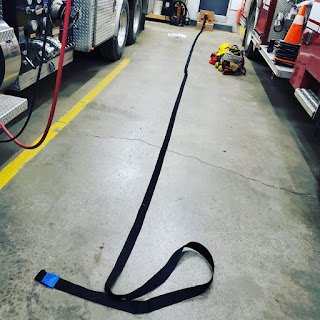
I had a few boxes kicking around, but I needed something to emulate a hose. A local craft store had rolls of 2 inch webbing and I figured that would be good enough. I cut a long length into two pieces. After taping one end into the ‘bed’ I rigged up inside the box, I tied a water knot with the other end to connect the two lengths together. In one way, this let me drill the water knot, in another it stood in place as a coupling in my miniature hose so I could practice staging it correctly when packing the hose. 

Attending the station with my staple tea and IFSTA manual, I used this little prop to pack a variety of loads with no stress in a comfortable environment. That process allowed me to really understand the different loads not only from my course manual but from the trucks in our bay. Even as I write this, it would probably be a good idea to mock this up again - just to stay sharp.

Learn the trucks

Perhaps your most valuable skill on the first few nights you’re called out will be a rich understanding of your trucks. These rolling tool boxes have all kinds of compartments to tuck in the gear we need to do the job. Though you might not be called upon to operate those devices, you can make yourself an expert in their procurement on the scene. 

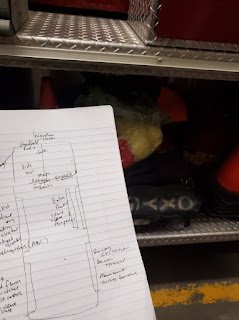
For one month, I set about documenting every single compartment - from the glove box to the back step auto-ex gear - on our pumper. It began as a chicken-scratch chart in my station drills notebook.

You have a station drills notebook, don’t you?

Over a few evenings, I had a detailed list of every nook on that truck. Through the course of that activity, I found a few things I’d had no idea were tucked in behind gas cans or flare boxes. A truly valuable exercise in discipline and attention to detail, memorizing your trucks can be a time-saving skill during a call.  

To take this project one step further, you could formalize this process for recruits that follow in your footsteps. To build on the foundation set under your own feet by the firefighters that packed these compartments when the truck first rolled into its spot in the bay. 

Take your handwritten note and type it into a document. Take pictures and label them to make the document easier to follow than a simple list. Print that out and store it in your locker or - if you’re lucky and the station leadership permits - with the rest of the inventory documentation. You can take the digital copy and archive it into a repository, too - because this won’t be the last thing you type up for the station and a digital backup of your hard copy is a great thing to append to an email if a recruit in the future has questions about the truck.

When you accept the call, you are different from the person you were. There are things that need done now - not only because it’s the right thing to do, but because you owe that to the people who set the stage for your career. There is a standard to meet and with it, a weight of responsibility most people can not attend to. You were invited into this uniform because you volunteered. Showing up isn’t enough.

About the Author

Bill Dungey is a probationary volunteer firefighter in Brant, Ontario, Canada. He is focused on fitness, mindset development and finding training opportunities to help the fire service make things better.

The Wedge can be downloaded from https://timeandeffort.ca