Building a Repeatable Growth Model (RGM) in the Fire Service

In firefighting, consistency saves lives. Whether it’s pulling hose, conducting a primary search, or commanding a structure fire, we rely on repeatable actions under pressure. But what about developing firefighters themselves? What about growing officers, strengthening crews, and building leadership? That’s where the Repeatable Growth Model (RGM) comes in.

An RGM for the fire service is a structured, scalable way to develop personnel, improve operations, and grow leadership—consistently and predictably across your department.

What Is an RGM in the Fire Service?

A Repeatable Growth Model is a system that ensures:

  • Firefighters grow with purpose and direction

  • Officers are built through training, mentorship, and challenge

  • The department operates with consistent expectations and standards

  • Leadership capacity increases without depending on chance

It’s about creating an environment where growth is not optional—but expected, and where success is measurable, trainable, and repeatable.

Six Pillars of a Fire Service RGM

1. Clear Standards and Expectations

The foundation of any high-performing organization is clarity. Every rank—firefighter, engineer, officer, chief—should know:

  • What’s expected

  • How success is measured

  • How they can move to the next level

This includes well-written SOPs/SOGs, job performance requirements, and task books that are actively used, not just filed away.

2. Structured Training Progression

Training should be layered, logical, and progressive:

  • Probationary firefighter: Basic tactics and crew operations

  • Senior firefighter: Advanced fireground leadership, RIT, mentoring

  • Officer candidate: Command simulations, personnel management, public interaction

Repetitive exposure to realistic scenarios builds confidence and competence.

3. Mentorship & Coaching Systems

You can’t scale growth without leaders who know how to develop others.

  • Pair new members with proven mentors

  • Train officers to give constructive feedback and act as coaches

  • Make feedback expected, not feared

A strong mentorship culture turns experience into a multiplier.

4. Leadership Pipeline

Officers shouldn’t be chosen because “it’s their turn”

Instead, develop a repeatable path to promotion, such as:

  • Formal officer academies

  • Acting officer opportunities

  • Peer leadership programs

  • Leadership simulations (e.g., tabletop, ride-alongs with command officers)

If you want better officers, build them, don’t just promote them.

5. Performance Review & Feedback Loops

Performance evaluations shouldn’t just be administrative.

They should:

  • Reinforce accountability and progress

  • Identify areas of strength and growth

  • Be backed by observable behaviors, not opinions

  • Happen consistently, not just annually

Honest feedback helps people grow. Silence does not.

6. Mission-Driven Culture

Finally, none of these works without a shared purpose.

  • Every firefighter should know the “why” behind the standards

  • Core values like service, humility, grit, and teamwork must be modeled

  • Leadership should constantly tie growth back to mission readiness and public trust

Culture eats policy for breakfast. So, build one that drives your growth forward.

Why RGM Matters for Your Department

Without a structured growth model:

  • Training is inconsistent

  • Promotions feel political

  • Morale and performance drift

  • You lose good people to stagnation or frustration

With an RGM in place:

  • Firefighters know how to grow

  • Officers are built, not guessed

  • Culture is consistent, not chaotic

  • Operational performance improves

What a Simple RGM Can Look Like

Stage

Repeatable System Example:

  1. Recruit Onboarding

    12-week academy + post-academy mentor checklist

  2. Probation Phase

    90-day evals + structured skill progression throughout first year

  3. Continuing Education

    Annual training calendar + company-level drills

  4. Officer Development

    In-house leadership school + acting officer assignments

  5. Succession Prep

    Command simulations + 360-feedback + coaching

Ready to Build an RGM for Your Fire Department?

Start small. Pick one area to standardize—probationary training, officer development, mentorship—and build from there. Growth doesn’t have to be overwhelming. It has to be repeatable.

If you're a training officer, chief, or aspiring leader, I’d be happy to help you map out your department’s version of an RGM—from templates and evaluation forms to leadership curriculum and SOPs.

Because better firefighters don’t happen by accident. They happen by design.

Until next time, work hard, stay safe & live inspired.

The Search & Rescue Mindset

When others run out, we go in. When chaos hits, we bring order. Cliché? Yes, I know but every second counts and every move matters.

Search and rescue isn’t just a fireground function, it’s a mindset forged in pressure, sharpened by repetition, and grounded in trust. When lives are on the line and visibility drops to zero, disorientation tends to rear its ugly head yet it’s the mindset that separates hesitation from action and action from success.

The mission is clear but the mind must be sharper.

In a true rescue scenario, there are no do-overs. No mulligans. Victims may be unconscious, disoriented, or trapped. Conditions are loud, dark, and rapidly deteriorating. But the trained rescuer is calm, decisive, and clear-minded.

SAR isn’t about running into danger blindly. It’s about calculated movement, methodical searches, and mental clarity under stress. You’re not just entering a structure, you’re entering a puzzle. Every room, every clue, every sound matters.

Stay Calm Under Pressure

Panic spreads faster than fire. In rescue situations, your crew feeds off your composure. You breathe slower. You move with intention. Calm isn’t a weakness, it’s tactical control.

Trust Your Training

You fall back on the reps. The hours spent drilling primary and secondary searches, victim drags, and MAYDAY protocols aren’t just checkboxes, they are lifelines when everything goes sideways. If it’s muscle memory, you’re ahead of the game.

Never Leave a Fellow Firefighter Behind

Search and rescue is a team effort. We go in together, and we come out together. Situational awareness, crew integrity, and accountability are non-negotiable. You may find a victim, but if you lose your partner in the process, the mission is compromised. Rescue success starts with team survival.

This isn’t just a job, it’s a mission.

Search and rescue is one of the most demanding responsibilities in the fire service. It requires heart, grit, and a refusal to quit when others fold. It’s not about glory, it’s about service. It’s about being calm in the storm, hope in the darkness, the one who goes in when no one else will.

This mindset isn’t switched on when the tones drop rather it’s built daily, in training, in fitness, in discipline, and in purpose.

Be Ready. Stay Sharp. Live the Mission.

Until next time, work hard, stay safe & live inspired.

What is Your Reason? A Firefighter’s Reflection on Purpose, Passion, and Perseverance

In the fire service, we pride ourselves on being ready for anything — chaos, crisis, catastrophe. But behind every call we run, every drill we sweat through, and every sleepless night spent under fluorescent lights… there’s a deeper question we all need to answer:

“What is your reason?”

Not just why you became a firefighter — but why you stay. Why you show up early, train harder, push further. Why you take the hard calls personally, and the easy days humbly.

Maybe your reason is your family — the ones you kiss goodbye before every shift, knowing each one might be different. Maybe it’s your crew — the people who’ve got your back in zero visibility and life-or-death moments. Maybe it’s duty — a calling to serve when others run. Or maybe it’s growth — becoming stronger, sharper, and more disciplined with each challenge.

The fire service will test you. It will stretch your limits. It will expose your weaknesses. It will humble your ego. But your reason — your why — will anchor you. It’s what keeps you from quitting when you're broken, what gets you up when you're tired, what reminds you that you are part of something much bigger than yourself. And beyond the firehouse, this mindset applies to life itself.

We all face our own “burning buildings” — stress, loss, fear, failure. We all fight unseen battles. We all have moments where quitting feels easier than continuing. But purpose makes the pain worth it.

Reason gives resilience. So ask yourself — Why do you do what you do? What legacy are you building? Who or what are you fighting for? Whether on the fireground or at home, know your reason.

Let it shape your mindset. Let it lead your actions. Let it define your story.

Because when the heat turns up — in life or in the job — your reason is the only thing that will keep you moving forward.

Until next time, work hard, stay safe & live inspired.

No Matter How Strong Your Last Shift Was — Today’s Fire Doesn’t Care.

In the fire service, your mindset speaks to the perishable nature of readiness. You might have crushed a call last shift, made a great stop, or executed perfect teamwork — but that was then. Fires don’t care about your résumé. Emergencies won’t wait for you to catch up. Lives, property, and the safety of your crew depend on what you bring today.

Core Themes:

Complacency kills. Past success can lead to false security. Overconfidence is the enemy of vigilance. Every call is different. No two fires behave exactly the same. Tactics evolve. Conditions change fast. You’re only as good as your last rep. Mental sharpness, physical conditioning, and technical skills must be maintained. Yesterday’s training won’t carry you forever.

Earn it daily.

Respect the craft. Hone your edge. Show up to the station or the rig ready to win today’s game.

For the Crew Wall or Day Room:

“No matter how strong your last shift was — today’s fire doesn’t care.

Reset. Recommit. Reload.

This shift is a new game — and we play to win.”

Until next time, work hard, stay safe & live inspired.

Yesterday’s Hits Won’t Win Today’s Game

"Yesterday’s Hits Won’t Win Today’s Game"

We’ve all been there — the feeling after a solid stop on a working fire. Maybe it was a fast knockdown, a tough rescue, or spot-on ventilation. The kind of call that reaffirms why we do this job. But as great as that win feels, it doesn’t guarantee success on your next shift.

Yesterday’s hits won’t win today’s game” is more than a catchy phrase. It’s a cultural challenge. A mindset shift. In this profession, lives depend on how we perform under pressure — right now. The community doesn’t care about your highlight reel. The fire doesn’t care about your certifications. Each call is a new test. Are you ready?

This is why we drill. This is why we talk through runs, inspect gear with purpose, and train harder than the job requires. It’s not just pride — it’s survival.

So the next time you step off the rig, ask yourself: "Am I bringing my best game today?" Because yesterday’s performance won’t save a life tomorrow.

Until next time, work hard, stay safe & live inspired.

The Intent of Training

The definition of intent when related to the fire service is the underlying reason or purpose behind an action taken by a firefighter, officer, or department — particularly in fire ground decision-making. In the fire service, intent plays a crucial role in shaping decisions, actions, and leadership especially when it comes to training.

Training without intent is activity without impact. It burns time without building readiness — and that’s dangerous in a job where performance can mean life or death.

Training Intent:

“The intent behind this drill is to build muscle memory for a mayday scenario.”

Without clear intent, training can become just routine instead of purpose-driven. Then what happens?

Training without the purpose becomes a checkbox activity leading to many areas that will lose firefighters drive, motivation and build a scary level of complacency.

Due to this, firefighters will only be going through the motions or focusing on completing the training rather than the competency of the training leading to complacency and loss of critical perishable skills needed for success as a firefighter on the job. Furthermore, firefighters not understanding the "why" behind the training may not fully engage in the training, therefore losing its sense of relevance. When firefighter lose the relevance in their training meaning the intent of the training is gone, the training lacks real-world applications and fails to prepare firefighters for actual incidents.

Inconsistent outcomes will begin to grow when training has to intent. Without a clear objective behind the training, performances will tend to vary and the ability to measure improvement or success can oftentimes be difficult. Why? Because you cannot execute a plan, without understanding what the end result should look like.

Firefighters as we all are aware, respect training that respects their time and sharpens their skills. When the intent behind the training is missing, the morale and motivation to perform drops and the question gets asks, "why are we even doing this?"

Training should be built upon decision-making, confidence and leadership in addition to the skills that are looking to be developed or sharpened.

Until next time, work hard, stay safe & live inspired

You Can Never Know Enough

"You can never know enough, but you never know too much" — especially in the context of the fire service.

Here is a quick breakdown of its meaning and value:

"You can never know enough". What does this mean?

In the fire service, continuous learning is essential. Tactics, building construction, fire behavior, medical response, leadership, and technology are always evolving. No firefighter can ever say they've learned everything — there's always more to understand, train for, and improve upon. As the old saying goes, "the day we know everything is the day we retire". If we keep the mentality of continuous learning as essential, the possibilities of our potential therefore become limitless in all we do.

"But you never know too much". How can we speak upon this?

In critical situations, knowledge is power. The more you know, the better decisions you can make under pressure. Being overly prepared is not a liability — it's a lifesaving asset. In fact, having too much knowledge in this field simply doesn't exist.

The more we learn and the more we can translate the classroom knowledge to real-life situations in the training room and the fire ground, the better we become in our situational awareness of the incidents and the confidence we have in trusting knowledge and skills in the critical situations of the job. This is all about TRUST.

Why it does this matter?

Lives depend on it. The fire service isn't just about strength and courage — it's also about making split-second decisions based on training and experience. Translating classroom work, hands-on training and carrying over prior real-life fire ground experiences will enhance our fire ground decision-making and heightening our sense of situational awareness.

Knowledge builds confidence. A firefighter who understands their tools, team dynamics, building layouts, and fire behavior is more effective — and safer.

It promotes humility. Recognizing that you can never know enough keeps firefighters grounded and always seeking growth.

Because every call, every fire, every life depends on knowledge. Train relentlessly. Stay sharp. Stay safe.

Until next time - work hard, stay safe & live inspired.

What Gets Measured Gets Managed in the Fire Service

In the fire service, this principle emphasizes that by tracking and evaluating specific metrics, departments can improve performance, increase safety, allocate resources efficiently, and enhance community service. But it also comes with the caveat: measure the wrong thing, and you may manage the wrong priorities.

Speaking of measurements, let's briefly discuss NFPA 1710 and its impact on setting benchmarks for response times. NFPA 1710 is a standard developed by the National Fire Protection Association (NFPA) that sets performance benchmarks for response times in career fire departments. It defines specific timeframes for each phase of emergency response—from the initial call receipt to the stabilization of the incident. The main objective of the standard is to promote effective and timely emergency response to protect public safety, providing clear guidelines on staffing levels and operational timelines.

Factors that may affect response time are geographic layout, traffic conditions, staffing levels, equipment readiness and call volume.

The 2020 edition of NFPA 1710 introduced key updates to reflect the evolving demands on modern fire departments. One major change was an increased emphasis on emergency medical services (EMS), acknowledging the growing number of medical calls. The standard now requires EMS units to arrive within 8 minutes, 90% of the time, underscoring the critical need for timely medical response.

Another significant revision includes detailed response benchmarks based on occupancy types—such as high-rise buildings, single-family homes, and open-air strip malls—ensuring departments tailor resource deployment to specific incident scenarios with greater scalability and adaptability.

The updated standard also expanded crew size recommendations, particularly for high-risk or complex incidents, to improve firefighter safety and operational efficiency. In addition, it addressed emerging technologies, encouraging the adoption of tools like digital communication systems and real-time tracking to enhance coordination and situational awareness.

Overall, the 2020 updates strengthen NFPA 1710 as a comprehensive, modern framework designed to support effective emergency response and meet public safety expectations.

Below are key areas not specifically impacted by NFPA 1710 but areas of management that departments can identify to improve performance, increase safety, allocate resources efficiently, and enhance community service.

Response Times

Measured: Time from dispatch to arrival on scene.

Managed: Departments may adjust station locations, shift staffing, or invest in traffic preemption systems to reduce response times.

Example: A department notices longer response times in a growing suburban area. By tracking this consistently, leadership advocates for a new station in that zone to improve coverage.

Call Processing Time: No more than 64 seconds, 95% of the time.

Turnout Time: Firefighters should be suited and in their apparatus within 80 seconds for fire responses and 60 seconds for EMS calls.

Travel Time: First responders should arrive on the scene within 240 seconds (4 minutes) for fire suppression and EMS incidents, 90% of the time.

Call Volume by Type and Location

Measured: Number of EMS, fire, hazmat, and false alarm calls per area.

Managed: Resources (staffing, apparatus, training) are tailored to meet actual demand.

Example: If 80% of calls are EMS-related, the department may prioritize EMT training and consider deploying smaller, faster response vehicles for medical calls.

Firefighter Injuries and Near Misses

Measured: Frequency, type, and causes of injuries or close calls.

Managed: Safety protocols, PPE standards, and training are improved based on trends.

Example: A spike in ladder-related injuries leads to updated SOPs and targeted training sessions.

Training Hours and Competency

Measured: Training hours completed per firefighter, and performance on practical assessments.

Managed: Ensures compliance with standards (e.g., NFPA), identifies gaps, and supports skill development.

Example: If quarterly evaluations show low performance in RIT (Rapid Intervention Team) drills, the department schedules additional hands-on and classroom training to assist in improving RIT performance.

Fire Prevention Activities

Measured: Number of inspections, public education sessions, or code violations found.

Managed: Prevention programs and staffing are adjusted to reduce fire risk.

Example: Data shows increased violations in commercial kitchens, prompting a targeted inspection blitz and education campaign.

Community Risk Reduction (CRR)

Measured: Data on fire incidents, demographics, and high-risk properties.

Managed: Outreach and mitigation strategies are focused on vulnerable populations or high-risk buildings.

Example: Elderly residents in a mobile home park experience frequent cooking fires. The department installs stovetop fire suppressors and offers safety classes.

The Caution: Measure What Matters

If a department only measures response time, it might push crews to speed at the cost of safety. If it only tracks number of calls, it may ignore quality of service or fire prevention success. That’s why contextual, balanced measurement is key.

In the fire service, measuring the right things leads to better management—more effective responses, safer firefighters, better-trained personnel, and stronger community outcomes. But success depends not just on measuring, but on measuring what truly matters to mission effectiveness and public safety.

Until next time - work hard, stay safe & live inspired.

Beyond the Firehouse - The Value of Outside Training

If you’re reading this, odds are you care about sharpening your skills. You take training seriously, and you know that in this job, complacency kills. But even the most motivated firefighters can fall into routines that lead to stagnation. That’s why stepping outside your firehouse for training isn’t just beneficial—it’s necessary. Exposure to new techniques, tactics, and perspectives makes us sharper, more adaptable, and ultimately safer on the fireground. And if you’re wondering how to find quality training, stick around—there’s a great resource at the end of this article that makes it easier than ever.

If there is one thing I have learned in my career, it’s that there is always more to learn. And a saying I heard some time ago rings true, “Once you get outside the four walls of your fire house, you realize that the fire service has no walls.” Fire tactics, and strategies vary across the country, and being exposed to different approaches help build safer, sharper, and more well-rounded firefighters. Additionally, engaging in outside training on a consistent basis prevents stagnation, enhances skills and knowledge, and ultimately improves emergency response.

Although I believe that everyone has something to teach, and you can learn something from everybody; some of the most valuable insights come from experienced professionals who have dedicated their lives to advancing the fire service. I can personally attest to this, having had the opportunity to learn from fire service legends like Mike Lombardo, Aaron Fields, Bob Pressler, and Dennis LeGear. The knowledge and skills I’ve gained from their classes have been invaluable. As the fire service continues to become younger across the nation, how can today’s firefighters gain access to this wealth of experience and knowledge?

Beyond Your Department’s Walls

We’ve all been there; stuck in a rut, in-house training has become repetitive, uninspiring and everyone is just going through the motions. Outside training can break this cycle, challenge and expand firefighters skill sets and reinvigorate firefighter’s passion for the job. Many firefighters leave outside training feeling motivated and eager to apply and share what they’ve learned. That said, not everything taught in an outside course will fit neatly into every department’s operations. The key is to take what works, discard what doesn’t, and adapt what might be useful down the road.

Another huge advantage? Networking. Attending outside training puts you in the same room with firefighters from across the region — sometimes even the country. These connections become a priceless resource for sharing ideas, solving problems, and gaining fresh perspectives when you need them most. We’re lucky to live in an era where quality training and conferences are available almost everywhere. But with so many options, how do you decide which ones are actually worth your time?

Owning the Learning Process

Firefighters who want to grow can’t simply wait for their department to hand them opportunities—they have to seek them out. When looking for outside training, keep these key points in mind:

Identify training needs – Pinpoint areas that could use improvement. This doesn’t mean the department is struggling, but some skills get rusty without variety. For example, if extrication drills have looked the same for years, an outside class could introduce a new approach to training on it.

Choose relevant training – Choose training that aligns with your department’s goals, and capabilities. While training on a technical rescue discipline like high-angle rescue might sound exciting, it isn’t practical if the department doesn’t have the gear or capability to perform those operations. Stick to training that aligns with real-world needs.

Find budget-friendly options – Training can be expensive, but plenty of free or low-cost opportunities do exist. Government programs, industry-sponsored courses, and online offerings provide solid education without breaking the bank. Additionally, consider seeking alternative funding opportunities like engaging local organizations, or raising money through an event to help sponsor or support training initiatives.

Do your research – This is an absolute must! The fire service is full of self-proclaimed experts, but not all training is created equal. Research instructors, read course reviews, and ask fellow firefighters about their experiences before committing.

Share the Knowledge

A friend of mine once said, “Knowledge is power, but only if it’s shared”

If the department funded your training, it’s not just an opportunity — it’s a responsibility. Maximize the return on that investment by bringing the lessons back home. Take good notes, create handouts, and step up to lead an in-house training to pass along what you learned.

Taking the initiative to build a training plan and handle the prep work eases the burden on the training division, making it far more likely your new knowledge gets shared with the rest of the crew. The more value the department sees from sending you to outside training, the more likely they’ll support future opportunities — for you and others.

A word of caution however, how you share the information often matters more than the information itself. Humbly presenting new techniques as “a way” encourages productive discussion and creates buy-in amongst members. Conversely, arrogantly presenting the same information as “the way” will likely be met with resistance with little buy-in. Additionally, be sure to explain the “why” behind the technique, tactic, etc. and be open to member’s scrutiny–in fact, welcome it! Respectful debates around techniques and tactics lead to better decisions on the emergency scene, and when they hold up to scrutiny, credibility is created.

FireTrainingDirectory.com

As stated earlier, I am a proponent for outside training, but I found that when firefighters asked me, “Where do you hear about all these training events?” my typical response was “social media,” and that wasn’t exactly helpful. That’s why FireTrainingDirectory.com was created—a centralized database designed to make it easier to find upcoming training opportunities.

Building and maintaining a directory like this is no small task, so the project takes a crowdsourced approach.Similar to FirefighterRescueSurvey.com, where firefighters log civilian rescues, this site relies on submissions from the fire service community through the “Submit a Training” form found on the website. Once submitted, each listing is verified to ensure accurate dates, locations, and working URLs before training details go live. With any crowdsourced platform, there’s always a risk of errors, so users can easily report errors they find, no matter how small, allowing them to be fixed quickly.

The directory is up and running now! Currently, it offers basic search filters, but if firefighters find it valuable, more features and functionality will be rolled out over time. I encourage you to peruse the database and if you know of an upcoming training, please submit it.

In conclusion, outside training isn’t just about learning new techniques—it’s a cornerstone of staying sharp, safe, and engaged in the fire service. It prevents stagnation, broadens perspectives, and builds a network of like-minded firefighters who want to keep getting better. Whether just starting out or well into a career, investing in outside training is one of the best ways to stay at the top of the game. And now, with FireTrainingDirectory.com, finding those opportunities has never been easier.

Fire Training Directory

About the Author

Cole Kleinwolterink is a dedicated husband, father, and passionate firefighter/paramedic. After a fulfilling career as a middle school teacher and coach, he transitioned to the fire service in 2019. He now serves full-time with the Waukee Fire Department (IA) as a firefighter/paramedic and Field Training Officer, where he is deeply committed to mentorship, training, and service. Beyond his full-time role, Cole volunteers with the Granger Fire Department and teaches EMT and fire science at Des Moines Area Community College.

Are You an Asset or a Liability?

There are a few questions many of us as ourselves as we advance in our careers and go through life when leading or directing others:

- Am I an asset or liability to the team?

- As a leader, am I giving more than I am taking or am I taking too much?

- Is this role for me?

Each time we step into the firehouse we have a choice. The choice we have is how we are going to show up for ourselves, our crew, our department and our community. Surely, that is a lot of groups we have to show up for but the choice to do so lies within our own self.

So, what is the choice?

The choice is simple, we can be the pillar of strength and positivity that leads the team to serve to the best possible potential or it can be the pillar of negativity and defeat that merely goes with the flow just to get through the shift. Either way, that choice of which pillar you take lies solely with you. Ask yourself, what do you as a leader of today's fire service bring to the table? Am I showing up with the energy to positively impact and motivate the room or am I showing up with the energy that drains the room of all potential and drive?

If you're adding impact and motivating the room, you are an asset. If you're draining the room of potential and drive, you are a liability. I get it, we'll never be 100% energized all the time and will naturally have off days. It's common and part of the ebbs and flows of life. However, the long-term goal is what we need to strive for. The impact to leave on others when your time comes to hang it up, is to strive to be the asset and not the liability.

To be the asset or in order words, to be the firefighter you always wanted to look up to is this. Be consistent in your actions. Mentor, train and guide fellow firefighters when the time presents itself and show them you care. Lead by example with everything you do. From cleaning the station, to on-shift training, be the one who steps up and makes it happen without ever making a show out of it. This matters most even when no one is watching.

Think about your mood and the mood you're bringing to the station, to the kitchen table and onto the fire ground. That mood is contagious. Are you prioritizing your health before shift through proper sleep, hydration and recovery the night before? How you take care of your body and mind plays into how your mood and energy show up at the firehouse.

Lastly, encourage those around you, support them and position yourself to be the cornerstone of the team. So go out there continue training hard and striving to become the best version of yourself you could possibly be.

Until next time, work hard, stay safe & live inspired.

Be Adaptable

When you wake up each day are you prepared to handle what life throws at you? Are you ready to roll with the punches and adjust your thinking and your actions to accomplish your goals? Or are you anxious and uneasy about the possibility of encountering unexpected events?

Each day on and off the fire ground, in and out of the firehouse, we experience things we do not expect to occur or be part of the days plan. Part of growth and advancement is the ability to adapt to the changes of the environment around us. Yes, I said it. CHANGE. The two things firefighters do not like - change and the status quo. Kind of ironic isn't it? To go even deeper than that, us as humans in general do not like the word "change". We don't like the word so much that it's wired in our brains to become protective over our belongs when we hear the word "change". Where does that come from? It comes from the hardwiring in our brains which then causes the amygdala to release the "fight or flight" hormones as our response to "change"  as a way to protect our bodies from it.

 As firefighters and first responders we need to be receptive to change and to adapt to the current conditions around us. By doing so we are able to make wiser and often times safer decisions to the task at hand. If we are continually doing the same thoughtless type of decision-making and constantly repeating steps and decisions we've made in the past because "that's how we always did it" then we are not growing, advancing or thinking at all. We are staying in the sedentary state unable to keep up with the world and the advancements around us. As firefighters, we need to allow ourselves to adapt to the changes around us, which will then allow us to better efficiently utilize the resources around us and in turn display leadership. In the end, the fire service needs firefighters to step up and lead. As we know, leadership is contagious.

 Take a minute a think about the changes in your organization. Think about the small changes your organization has made over the years and how you were impacted by them and how you adjusted your mindset to adapt to them. In order to grow, it is imperative we look at the small changes taking place in our organizations and our lives and consciously develop ways in ourselves to adapt to them. When thinking of change, we need to take it in small steps. As we know too much of it or too much all at once, is too much for humans and society to digest. The "fight or flight" will kick in and where are we? Back at square one. Growing roots. Not advancing and not optimizing our lives to the best version of ourselves we could possibly be.

Until next time; work hard, stay safe & live inspired.

Probie Projects: Things You Can Do

I’m a brand new firefighter. In my volunteer station at the rural edge of a mid-sized city in Ontario, Canada, our crew is about 19 strong. When I first started, I was brought into the station by my captain to have a look around and at my first practice, a good handful of people were really welcoming. Very specifically, I have a feeling of gratitude toward my station and department for taking a chance on me and I’ve used that feeling to measure against the things I’m doing to help out or ‘put back’ into the station what they’re investing into me.

I believe that’s the right way to think about this, too. The department, the station and the crew you’re assigned to is owed your attention and effort. Past the social graces that you should already be plenty aware of, I’d like to make specific mention of the work you should be focusing on as a new firefighter. 

And how dare I. 

Afterall, I just passed the first year of service to my station. That’s an important note because it means the following ideas are based solely on my experience. You may need to round out some of the talking points here to fit into your particular experience. Still, approaching your new position with the mindset that you are ‘in-service’ to the fire service itself is the right way to act.


That might be a bit bold. A strong statement - especially from the new guy. But from my stance in the back of the truck, these seats are worn in from generations of firefighters that built a foundation that I have the privilege of standing upon. That lineage depends on us to carry it forward. Further than forward, it requires us to build. 

Taking responsibility

My argument is predicated on the idea that you should actively take responsibility for your involvement in the fire service. During our recruit training, I was exposed to a keynote speech from Mike Dugan at FDIC. His word rung through me and continue to help urge me toward the best possible output I can put forward. 

“Are you making a difference? If not, why not?”

Mike Dugan

You are responsible for improving the fire service. That responsibility adds weight to the metaphorical bar, and that’s okay. We should ask for opportunities to add to our sacred craft. 

Assuming the role of a firefighter who is invested in the trade will put you into an uncommon position. Where most people share little concern about their job, firefighters stand apart. We are not most people. 

Accepting the responsibility for making things better will mean there is more work to be done. It will place you into a category of people that ask for more even when the load is heavy to begin with. To accept that burden, a stalwart mindset must match the ability to take on more - make sure you’re prepared to work. 

Build something to learn

Using the word ‘something’ in this context is wildly open. I was lucky enough to be pinned into a station that allowed me to attend the hall to train whenever I wanted. That enabled me to get out there once my family had retired for the night and train things like SCBA donning, knots, medical rehearsal and most importantly learning the trucks. 

When I attended a station practice that would have us stretching a couple lines, I was mightily confused by putting the triple-layer load into real-world practice. Or, specifically, I had a hard time repacking it. I had a good idea behind the principle, but getting all that hose back on the bed gave me a real mental hiccup in the field. I recognized this and knew I had to act.

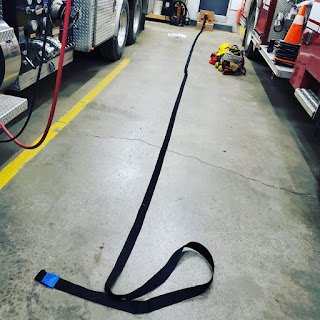
I had a few boxes kicking around, but I needed something to emulate a hose. A local craft store had rolls of 2 inch webbing and I figured that would be good enough. I cut a long length into two pieces. After taping one end into the ‘bed’ I rigged up inside the box, I tied a water knot with the other end to connect the two lengths together. In one way, this let me drill the water knot, in another it stood in place as a coupling in my miniature hose so I could practice staging it correctly when packing the hose. 

Attending the station with my staple tea and IFSTA manual, I used this little prop to pack a variety of loads with no stress in a comfortable environment. That process allowed me to really understand the different loads not only from my course manual but from the trucks in our bay. Even as I write this, it would probably be a good idea to mock this up again - just to stay sharp.

Learn the trucks

Perhaps your most valuable skill on the first few nights you’re called out will be a rich understanding of your trucks. These rolling tool boxes have all kinds of compartments to tuck in the gear we need to do the job. Though you might not be called upon to operate those devices, you can make yourself an expert in their procurement on the scene. 

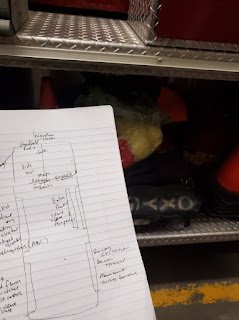
For one month, I set about documenting every single compartment - from the glove box to the back step auto-ex gear - on our pumper. It began as a chicken-scratch chart in my station drills notebook.

You have a station drills notebook, don’t you?

Over a few evenings, I had a detailed list of every nook on that truck. Through the course of that activity, I found a few things I’d had no idea were tucked in behind gas cans or flare boxes. A truly valuable exercise in discipline and attention to detail, memorizing your trucks can be a time-saving skill during a call.  

To take this project one step further, you could formalize this process for recruits that follow in your footsteps. To build on the foundation set under your own feet by the firefighters that packed these compartments when the truck first rolled into its spot in the bay. 

Take your handwritten note and type it into a document. Take pictures and label them to make the document easier to follow than a simple list. Print that out and store it in your locker or - if you’re lucky and the station leadership permits - with the rest of the inventory documentation. You can take the digital copy and archive it into a repository, too - because this won’t be the last thing you type up for the station and a digital backup of your hard copy is a great thing to append to an email if a recruit in the future has questions about the truck.

When you accept the call, you are different from the person you were. There are things that need done now - not only because it’s the right thing to do, but because you owe that to the people who set the stage for your career. There is a standard to meet and with it, a weight of responsibility most people can not attend to. You were invited into this uniform because you volunteered. Showing up isn’t enough.

About the Author

Bill Dungey is a probationary volunteer firefighter in Brant, Ontario, Canada. He is focused on fitness, mindset development and finding training opportunities to help the fire service make things better.

The Wedge can be downloaded from https://timeandeffort.ca