Life safety on the fire ground is top priority not only for the citizens affected by the incident but also us as the first responders on the scene. By establishing that priority early on, it sets the tone for how firefighters can operate at that given scene. Each of us want to be safe and ensure we go home to our families and so do the ones overseeing the scene, they want and expect the same for us and themselves. Unforeseen circumstances could always arise in this line of work while working in an immediately dangerous to life and health (IDLH)atmosphere that could injury, trap or cause a firefighter(s) to go missing and because of this a dedicated team of specially trained firefighters or what we know as a rapid intervention crew (RIC), are to be established and maintained to rescue a fellow firefighter in distress. Going even further than that, this team must be incorporated into their incident management system and accountability system as per NFPA 2014. So what is the reason for this dedicated crew to standby incase a firefighter goes down?
Here’s are 5 tragic events that changed the course of the fire service and opened the eyes for the need for rapid invention implementation.
1. Columbus, Ohio on July 25, 1987. One firefighter fell through the floor into the burning basement, as conditions deteriorated and several rescue attempts using hoselines, ropes and ladders failed, rescue attempts were halted and this firefighter perished. The “Nance Drill” was then created from these events after it claimed the life of Acting Officer Firefighter John Nance.
2. The Hackensack Ford Fire in Hackensack, NJ on July 1, 1988. Five firefighters get lost and trapped while fighting a fire in the car dealership after the truss roof collapsed and ultimately claiming their lives.
3. Denver, CO on September 28, 1992. One firefighter became separated from his crew and due to a collapse, intense heat and heavy smoke this firefighter was trapped in a storage room with an aisle only 28 inches wide. Firefighters quickly setup ground ladders and removed window bars but it was ultimately too late. This firefighter perished on that day. The “Denver Drill” was then created from these events after it claimed the life of Firefighter Mark Langvardt.
4. Passaic, NJ on May 9, 2001. One firefighter became trapped while searching for victims on the second floor of an apartment building.
5. Philadelphia, PA on August 20, 2004. Two firefighters were killed and a third was injured after becoming trapped in the basement of a one-alarm fire.
All 3 of these tragic events had no rapid intervention crew established.
There are many reasons a rapid intervention crew could be activated on the fire ground and unfortunately this team of specially training firefighters are entering probably the most dangerous area of the structure; the place where a firefighter(s) is in distress and calls for help, otherwise known to the fire service as a “MAYDAY”. The reasons for a “mayday” vary but each one should be acted upon quickly and efficiently.
Reasons for a “MAYDAY” and the activation of RIC.
1. Firefighters run out of air. Possibly due to large areas being worked in.
2. Excessive heat which could cause a heat stroke or a cardiac event.
3. Lack of visibility leading to crew separation and firefighter disorientation.
4. Crew separation due to the possible complexity of the floor plan.
5. Structural collapse
At any given moment one of these could be messaged over the radio to the Incident Commander and the activation of the rapid intervention crew will need to take place. In order for RIC to be readily available to go to work, a few things need to take place in the anticipation something could go wrong at any moment.
1. The first 10-15 minutes of a fire is most critical. Have RIC established early on and the RIC officer meet face to face with the IC for any pertinent information that could assist them in their efforts should they be activated. Establishing RIC from the start will help them with deployment and setup time. Also, most RIC established are outside agencies and will need time for travel.
2. The RIC officer should establish a staging area for the crew and all their necessary equipment along with devising a game plan should they be activated.
3. Develop your own size up of the structure and make it continual throughout the duration of the job since things change.
4. Determine how many crews are in the structure and the number of manpower on each crew. This will help with your S&T if you should be put to work.
5. Assist with egress. Take a proactive approach and setup ground ladders for crews operating on upper floors.
6. Time is critical. Stabilizing the situation quickly is the goal and working with the IC to develop a game plan for efficient firefighter removal (quickly yet systematically) before entering the structure will assist in those efforts.
7. Bring the tools that are warranted for the situation. As mentioned earlier, RIC has a staging area for crew and tools so it is possible and necessary to stage more tools than you’ll need to go in with yet having excess tools readily available is just as important.
Tools of RIC
1. Staging tarp for tools
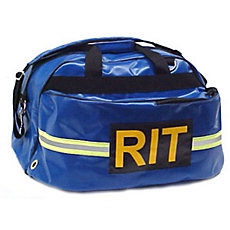
2. RIC Pack – rescue SCBA
3. Forcible entry tools such as a Halligan bar or other pry tools
4. Stokes basket
5. 150-foot search rope
6. Wire cutters
7. Saws (i.e K-12, chainsaw)
8. Thermal imaging camera
9. Box lights
10. Strobe light to identify egress
11. Life-saving rope/life belt
While there is no viable proof that having an established RIC in place will prevent firefighter fatalities on the fire ground, it is necessary in having one established and ready to go as a way to assist with the rescue and removal of a down fellow firefighter in hopes of a successful save. Any time departments are working on large structures, it is best to have rapid intervention crews on each side of the structure for quicker deployments with hopes of mitigating firefighter fatalities. Further, having an established RIC is a fire service best practice for all scenarios with firefighters working in an IDLH environment. May the lives of the firefighters mentioned in this article and the lives of all the firefighters who have gone before us in the line of duty, may they rest in peace.
Until next time; work hard, stay safe & live inspired.
About the Author
NICHOLAS J. HIGGINS is a firefighter with 17 years in the fire service in Piscataway, NJ, a NJ State certified level 2 fire instructor, a State of New Jersey Advocate for the National Fallen Firefighter’s Foundation and is the founder/contributor of the Firehouse Tribune website. A martial arts practitioner and former collegiate athlete in baseball, Nick is also a National Exercise & Sports Trainer Association Battle Ropes Instructor, Functional Fitness Instructor and Nutrition Coach. He holds a B.S. in Accounting from Kean University, and a A.A.S in Liberal Arts - Business from Middlesex County College. Nick has spoken at the 2017 & 2018 Firehouse Expo in Nashville, TN as well as at numerous fire departments within NJ and fire service podcasts.